

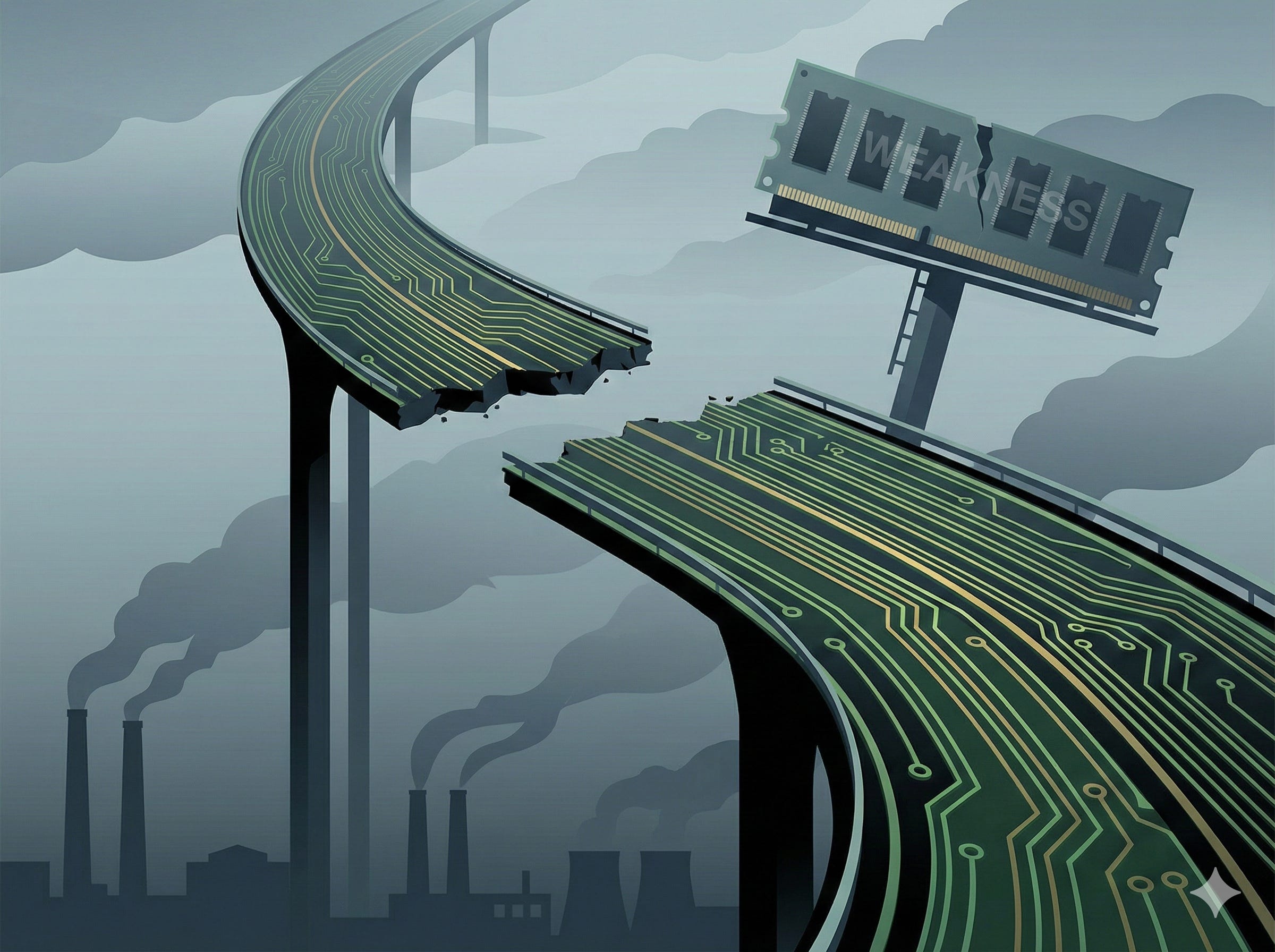
This week, the tech industry felt like a cartoon character who runs off a cliff, keeps running on thin air, and only falls after looking down. The ground beneath our feet — cheap memory, abundant power, the promise of clean tech — is suddenly giving way. We’re finally getting the bill for progress, and it turns out there are no returns.
PROGRESS DEMANDS A SACRIFICE
AI Gobbles Up Memory as the global RAM shortage persists into 2027, raising PC and phone prices. Data Centers Spike Power Bills as Democratic lawmakers launch an investigation into their impact on consumer electricity costs.
THE SOLUTIONS HAVE PROBLEMS
China Confronts Battery Graveyard as its massive EV boom creates an overwhelming battery disposal crisis.
THE TOOLS TURN AGAINST YOU
AI Flags Clarinet as Gun leading to a school lockdown, with the security firm claiming the system performed as designed. LG Hijacks Your Smart TV by initially forcing an unremovable Microsoft Copilot shortcut onto its new TVs before user backlash prompted a reversal.
Curious what it all adds up to? Let’s break it down. Keep reading below.
Tell Me More
The AI Hunger Tax. The AI gold rush is levying a hidden tax on every consumer, payable in the form of pricier phones and laptops. As Big Tech diverts the world’s memory supply to power its data centers, the era of cheap, abundant components is officially over. Expect PC and phone base prices to jump 10-15% by late 2026 as this supply crunch becomes the new normal. Welcome to the trickle-down economics of artificial intelligence.
Your ChatGPT Query Powers a Coal Plant. The abstract magic of generative AI is colliding with the hard physics of the power grid. Lawmakers are finally connecting the dots between the AI boom and soaring utility bills, as the industry’s insatiable energy appetite forces unpopular decisions about fossil fuels. By 2027, don’t be surprised when “AI Energy Surcharges” start appearing on utility bills in data center-heavy regions like Virginia and Georgia. Progress, it turns out, has a carbon footprint.
Green Tech’s Dirty Little Secret. China’s EV revolution has a massive hangover: millions of dead batteries with nowhere to go. The country’s recycling infrastructure is completely overwhelmed, revealing the folly of incentivizing mass adoption without planning for the entire product lifecycle. This isn’t a bug in the green transition; it’s a feature of a system that prizes short-term growth over long-term sustainability.
The Algorithm Cried Wolf. This isn’t a story about a single software error; it’s about the catastrophic failure mode of outsourcing critical judgment to brittle systems. An AI flagging a clarinet as a rifle is bad, but the company’s insistence that this wasn’t an error is terrifying, revealing a deep refusal to acknowledge the real-world consequences of its product. When the machine makes a mistake and its creators call it a success, public trust becomes the first casualty.
The Uninvited Guest in Your Living Room. LG’s decision to force a Copilot app onto TVs is the endgame of the smart device era, where you don’t own a product, you just rent screen real estate for advertisers. The company’s reversal after a public outcry proves that protest still works, but the initial impulse reveals their true intent. Your television is no longer a window to the world, but a billboard that you paid for.
Below The Fold
People are paying to get their chatbots high on ‘drugs,’ because reality wasn’t weird enough. Wired
Ireland’s Diarmuid Early wins the world Microsoft Excel title, proving human mastery still matters in a world of AI-generated slop. BBC
A filmmaker made a Sam Altman deepfake and got unexpectedly attached — the Tamagotchi for the uncanny valley. Wired
Hydrogen emissions may be quietly worsening climate warming, because the road to hell is paved with leaky pipes. Interesting Engineering
Exxon proposes massive gas-fired data centers, promising to capture emissions — the “low-carbon” solution brought to you by the people who created the carbon. Heated.world
The cure for misinformation is not more information, but fixing trust; turns out the problem isn’t the signal, it’s that we broke the receiver. Volts.wtf
An inexplicable live fish was found in a friend’s living room, which is the universe’s occasional reminder that it runs on chaos magic. alislagle.substack.com
A developer who wrote a code editor in C is now a changed man — the digital equivalent of building your own cabin in the woods. GitHub
Strava puts its popular “Year in Sport” recap behind an $80 paywall, monetizing the one thing that made people feel good about themselves. Ars Technica
A US court rejected Apple’s appeal, ending its ban on alternative in-app payments and scoring a rare win for the little guy against the 30% tax. The Pragmatic Engineer
Looking Ahead: Next week, expect more of tech’s chickens to come home to roost, as the real cost of ‘free’ and ‘fast’ becomes impossible to ignore.
Thanks for reading Briefs — your weekly recap of the signals I couldn't ignore. This week that meant reading 897 stories from 49 sources. You're welcome.