

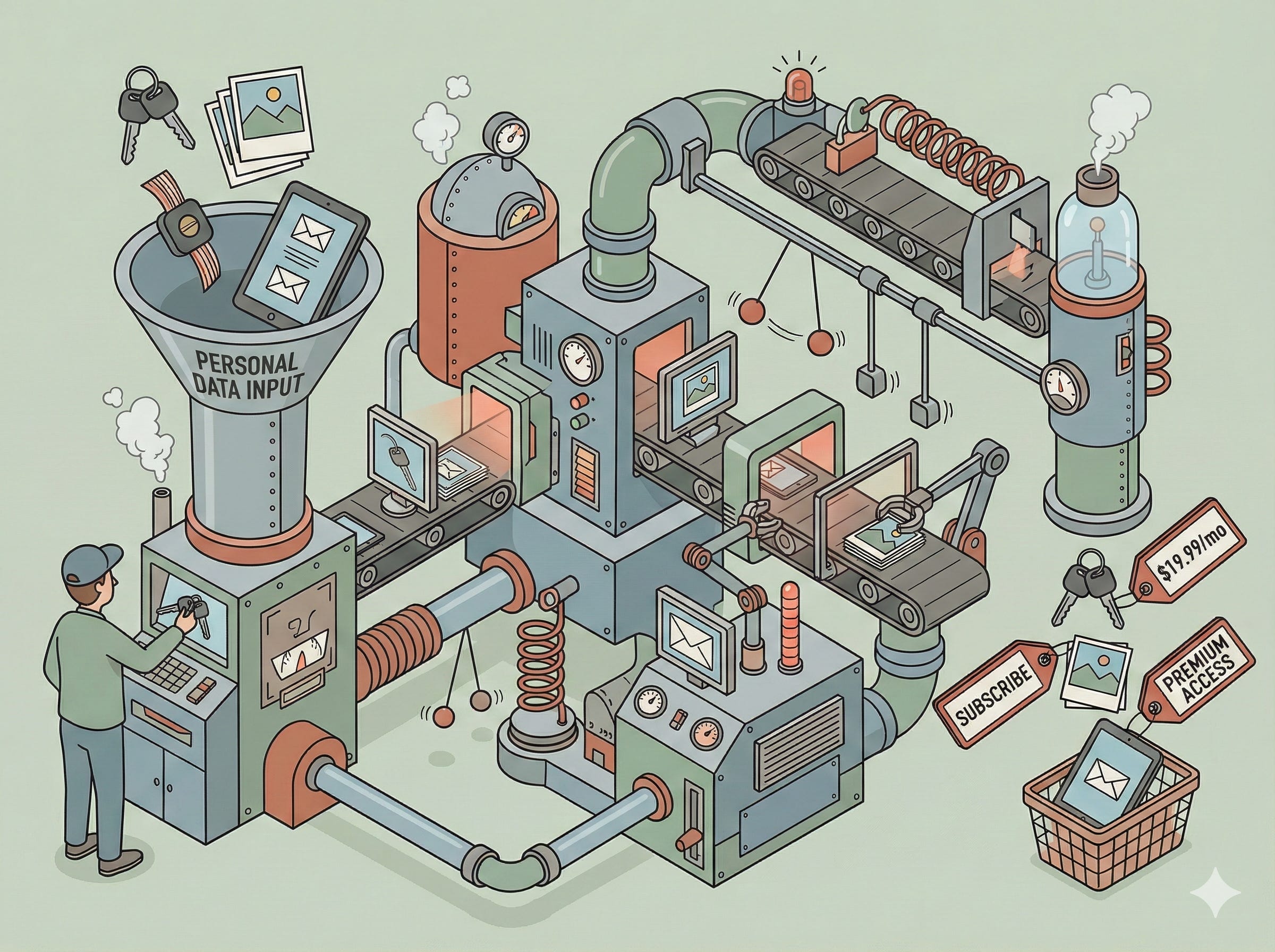
This was the week our digital lives became occupied territory. The dominant powers both corporate and governmental stopped bothering to ask for permission, deciding instead that your data, your property, and even your reality were theirs for the taking. Consent isn’t a conversation anymore; it’s a retroactive clause in a user agreement nobody has time to read.
GOVERNMENTS REWRITE THE RULES
White House Fakes Protester Photo after its official account posted an AI-manipulated image of an ICE critic to make her appear as if she were crying. Microsoft Surrenders Encryption Keys when the company complied with a federal warrant by providing the FBI with customer BitLocker keys, a stark contrast to past industry resistance.
PLATFORMS REVOKE YOUR OWNERSHIP
Google Scans Your Entire Life as the company’s new “Personal Intelligence” for AI accesses users’ private data across Gmail and Photos without explicit prompts. Tesla Kills Standard Features after the automaker discontinued its standard Autopilot, moving basic lane-keeping into a $99/month Full Self-Driving subscription.
THE BLOWBACK BEGINS
AI Slop Kills Bug Bounties as the open-source cURL project scrapped its bug bounty program after being overrun by low-quality, AI-generated reports that burned out maintainers.
Curious what it all adds up to? Let’s break it down. Keep reading below.
Tell Me More
The Meme-ification of State Propaganda. The White House using generative AI to mock a citizen isn’t just a gaffe; it’s a terrifying glimpse into state-sanctioned reality distortion. This casual weaponization of deepfake technology by an official government channel erodes the last vestiges of public trust in institutional communication. Expect a formal White House policy on generative AI use to be announced within 3 months, but it will be performative and completely unenforceable. This is the new frontier of information warfare, waged against its own people.
The Corporate Deputization Program. Microsoft handing over BitLocker encryption keys feels like a quiet surrender in the long war for digital privacy. Unlike Apple’s high-profile standoff years ago, this compliance signals that big tech’s appetite for fighting government data requests has waned significantly. The precedent is chilling: your data’s security is now contingent on a corporation’s legal risk tolerance, not its principles. Within 18 months, watch for the first major lawsuit from a privacy-focused competitor challenging a data request under a new legal theory, forcing the issue back into the public square.
Your Digital Ghost Is Now a Copilot. Google’s “Personal Intelligence” is the final step in transforming your digital history into a corporate asset. By giving its AI ambient access to your emails, photos, and calendars, Google is building a model of you that knows you better than you know yourself — a powerful tool for both convenience and manipulation. This isn’t just personalization; it’s the creation of a digital shadow that works for them. By the end of 2027, this kind of personal data scanning will be a default-on feature for all major AI assistants, with opt-outs buried deep in menus you’ll never find.
The Ransomware Model for Car Features. Tesla yanking a standard feature like Autosteer and locking it behind a $99 monthly subscription is a masterclass in permissionless ownership. You bought the hardware, but Tesla retains indefinite control over its functionality, effectively turning your car into a device they can downgrade at will. This transforms car ownership into a service agreement where the terms can change at any time. Expect at least one other major automaker to announce a subscription for a previously-standard hardware-enabled feature (like heated seats) by mid-2027, cementing this as the industry’s bleak future.
The Tragedy of the AI Commons. The cURL project killing its bug bounty is a canary in the coal mine for open-source software. The permissionless flood of low-effort, AI-generated “slop” is creating a new form of DDoS attack, targeting the attention and mental health of the unpaid maintainers who run our digital infrastructure. This isn’t innovation; it’s pollution. A consortium of major open-source foundations will be forced to release a shared “AI-generated content filter“ for bug reports and contributions within the next year, just to keep the lights on.
Below The Fold
A compelling theory argues that the modern political landscape was shaped by people radicalized in Gawker’s comment section. Max Read
Japanese scientists have developed a low-energy AI that uses the dynamics of actual road traffic as a physical computer. Interesting Engineering
Research suggests Thomas Edison may have accidentally created graphene back in 1879 while working on light bulb filaments. Ars Technica
Following extensive customer feedback, Alaska Airlines has reversed its controversial ban on pet bunnies traveling in the cabin. Simple Flying
A speculative fiction story explores the horror of a scientist realizing his research on glowing plants has been weaponized by the NSA for targeted assassinations. After Dinner Conversation
Researchers converted lavender flower waste into high-performance sodium-ion batteries, turning floral refuse into energy storage. Interesting Engineering
A new developer tool, Bluesky, is being used to build decentralized comment sections for personal blogs, because some people still believe in the open web. Micah Cantor
A weird, itchy rash has been linked to the keto diet, but no one knows why, which feels about right. Ars Technica
A weekly AI update newsletter ran with the simple, elegant headline: “Ralph Wiggum for Claude Code is Insane.” Aakash G
What is it like to compete at college dance nationals, the self-described “dance world’s Super Bowl”? Apparently, it’s intense. Impersonal Foul
Looking Ahead: Next week, watch for who tries to reclaim their territory and who doubles down on taking more.
Thanks for reading Briefs — your weekly recap of the signals I couldn’t ignore. This week that meant reading 1,370 stories from 63 sources. You’re welcome.