

Welcome to Frank Takeaways. I'm Frank, writing the notes worth keeping from decades at companies like Slack, Etsy, and Google. I run a coaching practice dedicated to guiding leaders through the tricky stuff of building products and high-performing teams.
Join my referral program and earn 1:1 coaching sessions by sharing Frank Takeaways with others - start with just three referrals.
—
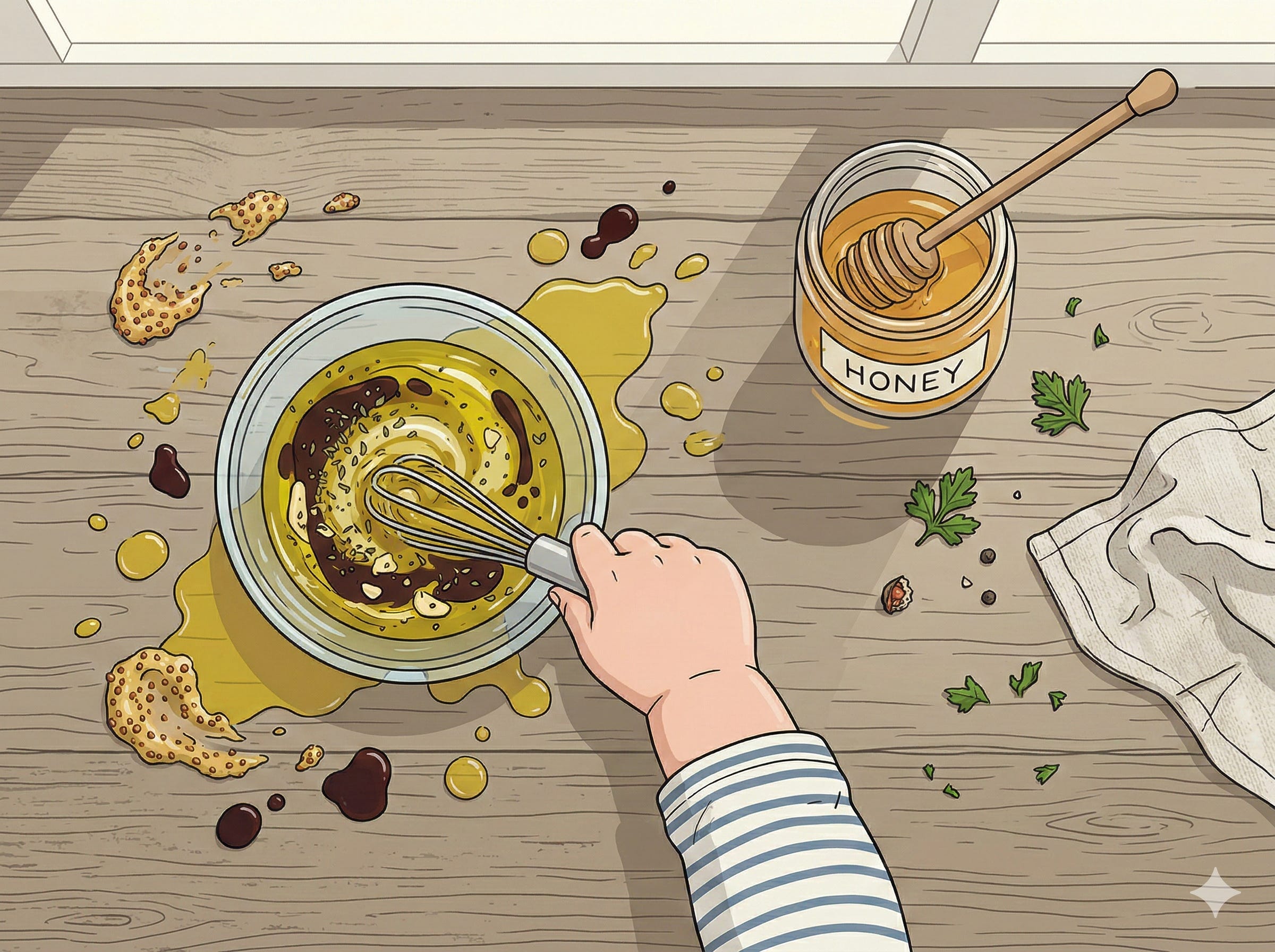
I was making a vinaigrette last Tuesday when my four-year-old asked if she could help. I handed her the whisk and she went at it. Aggressive, cheerful, completely wrong. Oil everywhere, mustard on the counter, vinegar pooling near the edge. I started to correct her technique, then stopped. She wasn’t learning to make vinaigrette. She was learning what happens when you combine things.
What separates a feature that works from a feature that feels right? That magical product taste. Every hiring manager says they want it but nobody can quite define it in a job description. We talk about it like it's a personality trait, something you either have or don't. I think that's wrong. It's an output.
We say it’s the human quality that AI can’t replicate, the last moat. Maybe. But if taste is an output, the models will get better at it too. Which is exactly why it’s worth understanding what the inputs actually are.
I’ve been building products and teams for twenty years and to this day, I always use some variation of the same question when interviewing candidates. I want to find out if they’re a product curmudgeon and an internal optimist for making things better. I look for taste. “Tell me about the worst product you’ve ever used.” “Tell me about the best product.” “How would you make it better? What would you do first?”
The stratification of answers unearths taste in short order. So what are the inputs? I think there are three.
Curiosity
You can’t develop taste in isolation. You need to use a lot of products, and not just the ones in your category or the well-known ones. You need to use bad products, too. Especially bad products.
When I was a UX designer at Google in the early days, I was using probably thirty or forty different web products a week. Not all of them were research. Most of it was just living on the internet. I remember Rdio, the music streaming app that died in 2015. It was better than Spotify in almost every way that mattered to me: the typography, the social features, the way it handled queuing. It lost anyway. But using it taught me something about the difference between a product that’s correct and a product that someone loved making. You could feel the care. I still think about Rdio’s album grid when I’m reviewing designs.
That volume built something. I started recognizing patterns before I could name them. I’d open a new tool and know within ten seconds whether the person who built it had thought carefully about the first three minutes of use. I couldn’t always tell you why. It was a feeling, like recognizing a chord change in a song even if you can’t name the key.
Volume of contact builds the library your intuition draws from. If your library is small, your intuition is shallow.
But curiosity isn’t just breadth. It’s also depth. At Betterment, I used our own product to manage my actual money. Not a test account. Real deposits, real transfers, real anxiety when the market dropped. When it’s your money, you notice the three-second delay on the portfolio page differently. That kind of friction doesn’t show up in any funnel chart. You have to live inside the product long enough to feel it.
I also signed up for every major competitor with real money and gave my entire team access to the accounts. Wealthfront, Wealthsimple, SoFi, all of them. I wanted everyone to feel what it was like to be a customer somewhere else, to notice where we were better and where we were embarrassingly behind. It was useful. It was madness come tax season.
The people whose taste goes stale are the ones who stop being curious. They found their aesthetic and their framework and their opinions, and they stopped looking. They coast on pattern recognition built years ago, and slowly, without noticing, their instincts fall behind. Curiosity is the engine. Without it, everything else decays.
But noticing what’s good isn’t the same as knowing how to make something good.
Craft
Almost everyone I know who has great product taste also makes things outside of product work. They cook, play music, build furniture, write. The specific discipline doesn’t matter. What matters is that they’ve experienced the gap between what they imagined and what they made, over and over, and they’ve learned to close it.
I enrolled in the bread course at the International Culinary Center a few years ago. COVID cancelled it before I ever walked in. But I’d already gone deep into baking on my own, and the obsession taught me something about product that no sprint retrospective ever did. In bread, you can’t fake it. The dough tells you immediately whether you paid attention during bulk fermentation. There’s no A/B test for a baguette. There’s just the crumb, and you know whether it’s right.
That sense of knowing-whether-it’s-right carries over. Once you’ve calibrated your senses in one domain, you start expecting the same level of care in others. You walk into an app and you can feel whether someone shaped it with attention or just shipped what compiled.
Katie Dill, Stripe’s head of design, put it well: things that are more beautiful increase trust. You see the painstaking detail, and it gives you assurance that they care about other details you can’t see. She’s describing what taste produces. But the thing that produces it is someone who knows what care feels like because they’ve practiced it somewhere.
Conviction
Having taste requires having a point of view. You have to be willing to say “this is bad” and “this is good” and “here’s why,” out loud, on the record, before you know how the thing performs. Taste without conviction is just observation.
But conviction alone is dangerous. I’ve watched brilliant leaders hold onto opinions long past the point where the evidence turned against them, because the opinion had become part of their identity. The fix isn’t less conviction. It’s a feedback loop. Annie Duke talks about this: making your implicit judgments explicit so you can find out when they’re wrong. Your intuition is sometimes right. But if you never surface it, you never learn when it isn’t.
Let’s call her Marta. She was a product director I coached last year. Incredibly smart, strong opinions about everything. Her team loved her conviction until they didn’t. It wasn’t that she was wrong more than anyone else. She just never tracked when she was wrong, so she never updated. I suggested she start a decision log. Nothing elaborate, just a note every time she made a product call: what she decided, why, what she expected to happen. Every quarter, she’d review it. Three months in, she started catching her own blind spots. Her opinions didn’t get weaker. They got more accurate.
Conviction also means knowing what to remove. At Etsy, I was known for killing features. It became a Friday ritual. Most of the time nobody noticed, and what was left got better. Shopify has something called the Delete Code Club where they regularly find a million-plus lines of code to cut. That’s not cost-cutting. That’s curation.
Aparna Chennapragada, Microsoft’s CPO, made this point recently: in a world where AI makes the supply of ideas and prototypes an order of magnitude higher, the editing function is what matters most. When everyone can generate, the value shifts to the person who knows what to keep and what to kill.
Before the World Ends
If taste is learnable, then it’s also teachable. Look, maybe the models do get good enough at taste that half of this becomes moot. In the meantime, here’s what I’d do right now, whether you’re trying to sharpen your own or raise the bar for your team.
Tinker. This is the most important one. Not efficiency. Not “AI adoption.” Actual unstructured exploration where 80% of what you try fails. If you’re a leader you have to create space for your team to do this — and you need to do it too. The first two months might feel like a loss. That’s how it’s supposed to feel.
Use something new every week. Not a demo. Actually use it. Sign up, put real data in, hit the edges. Write down what you notice. Your intuition library only grows when you feed it.
Make something with your hands. Cook a meal from scratch. Build a shelf. Write something that isn’t a PRD. The point isn’t the output. It’s training yourself to feel the gap between what you intended and what you made.
Start a decision log. Every product call you make, write down what you decided and why. Review it quarterly. You’ll be shocked how quickly your blind spots reveal themselves.
Kill something. Look at your product, your roadmap, your backlog. Find the thing that’s technically fine but not actually good. Remove it. See if anyone notices. They probably won’t.
My daughter eventually got the vinaigrette mixed. It was lumpy and oversalted, and she insisted on tasting it straight from the bowl with a spoon. She made a face, thought about it, and said, “More honey.”
She was right.
You just have to keep combining things and noticing what happens when you do.