

Welcome to Frank Takeaways. I'm Frank, writing the notes worth keeping from decades at companies like Slack, Etsy, and Google. I run a coaching practice dedicated to guiding leaders through the tricky stuff of building products and high-performing teams.
Join my referral program and earn 1:1 coaching sessions by sharing Frank Takeaways with others - start with just three referrals.
—
I grew up playing a lot of tennis. My semi-western forehand is older than most of my friendships. I don’t get out as much as I’d like these days, but every June the long tennis summer opens up in front of me. Roland Garros, then breakfast at Wimbledon, then night matches at the US Open. I get pulled back in. I never talk during a tiebreak.
Lately I’ve been thinking about Andy Roddick.
Twenty years ago, Roddick limped out of the French Open in the first round. He’d rolled his ankle the week before, taped it heavily, and retired early in the third set, down two sets to love, hobbling off Court Suzanne-Lenglen to boos from the Paris crowd. It was the fifth seed’s third first-round exit in six trips to Roland Garros, the major that never liked him back. A month later he hired Jimmy Connors.
The ankle healed. The thing underneath it didn’t. Roddick’s game had gone flat, and he knew it: too conservative on the points that mattered, leaning on his serve to bail him out instead of going forward and taking the point himself. He wanted to play with some teeth again. Connors had built a whole career on teeth, which made him an obvious choice, and an unconventional one. Connors had never coached.
But wanting that and knowing how to get there turned out to be two different things. Roddick showed up to one of his early sessions expecting to get straight to it. Connors stopped him before he’d hit more than a few balls. By Roddick’s own account, he roasted him.
“In the first ten minutes, your footwork is average. Tour average at best.”
And the berating continued. The ball’s coming slow right now, he said, so why aren’t you using it to get the reps in, before everything speeds up and you can’t?
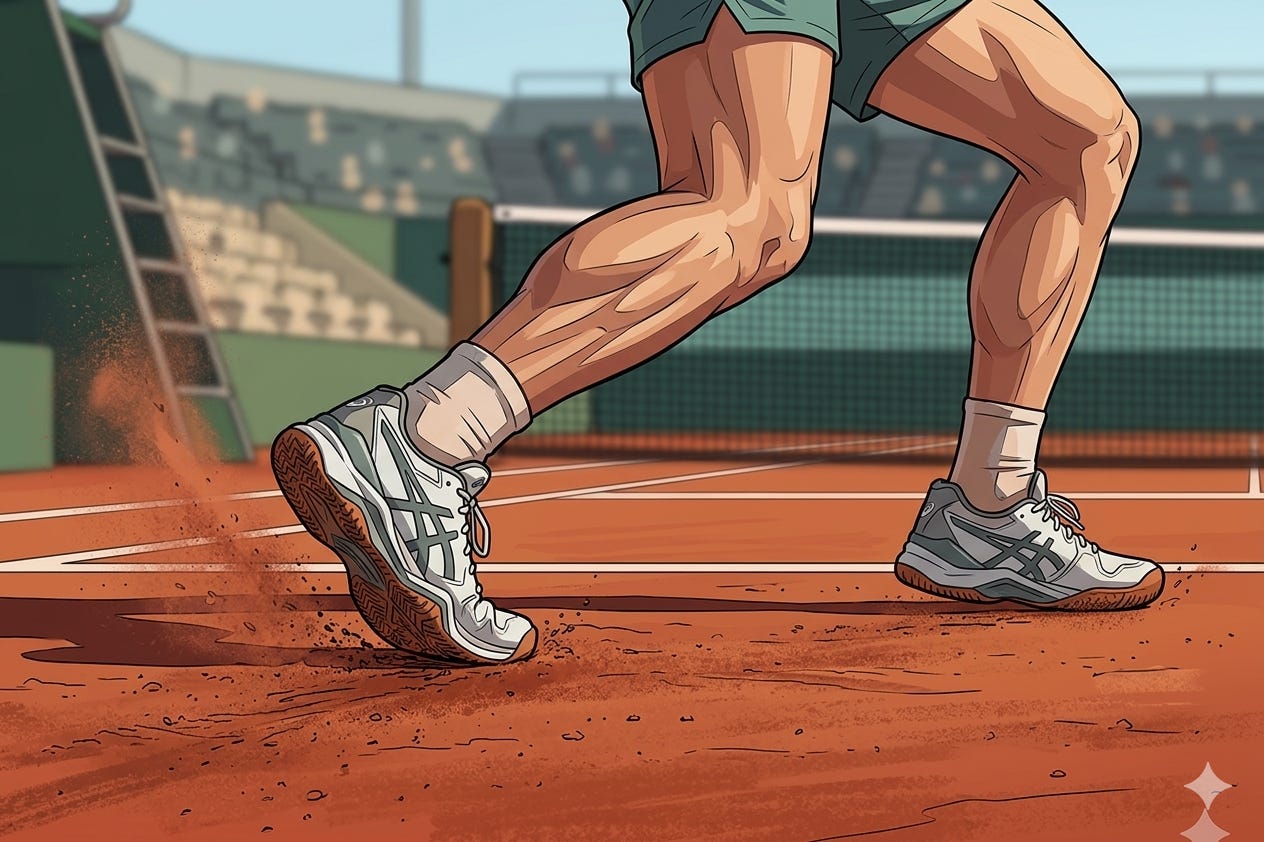
Those first ten minutes are a free run at proper footwork. The ball’s slow, nothing’s riding on it, and it’s the only window you get before the match starts making you pay for getting it wrong.
Roddick had hired a coach to fix his attack. Connors looked at his feet.
What Connors Saw
Roddick was no beginner. He’d been near the top of the sport for years, coached and analyzed by people who understood it cold, and he had a clear read on his own problem. The read wasn’t even wrong. He was passive. But the cause of it lived in a place he’d never thought to check. You don’t get to swing hard at a ball you’ve reached a half-step late. The footwork happened first and set the terms for everything after it.
His footwork wasn’t broken. That was the trap. It was good enough, every day, which is exactly why no one — including him — ever thought to look at it. It happened in the moment before the part anyone watches. And against the best movers in the game, Federer chief among them, it was the difference between getting set to do damage and getting pulled off the court before he could.
I had the same blind spot, on a much worse court. As a kid in lessons I wanted a bigger serve and a cleaner backhand. I wanted the shot you’d remember. Nobody fantasizes about footwork. It’s the part you’d skip if anyone let you, so I skipped it, and I stayed mediocre in a way I couldn’t explain and never thought to interrogate. To this day, when I meet someone who played a lot growing up but hasn’t picked up a racquet in years, I notice two things. The swing is still there. They never lose that. But the footwork is rusty. Timing and movement are the first to go.
Tour Average
That might be a compliment to you and me, but it wasn’t one for Andy. He’d been number one in the world, and the piece of his game Connors pulled out was, next to everyone else on tour, completely ordinary. Tour average. The plainest part of an elite player’s game, and the thing holding his ceiling in place.
Roddick put it this way on a podcast: “I have seen some bad players by tour standards — ball strikers, don’t serve big, can’t go through you — but they have great footwork... there have been top 100 players in the world because of it.”
Footwork with nothing else attached, enough to make you a pro. Which cuts both ways. If it can carry a player with no weapons, it can just as easily cap a player who has all of them.
And if it’s just working well enough, you might never see it. That’s the strange part about this kind of weakness. It isn’t a hole you fall into. It’s something you do passably, every day, so smoothly that it never lands on a list of things to fix.
Which is why it almost never shows up as a footwork problem. It shows up as a swing problem.
Watch the Feet
Imagine you’re walking into a meeting you’ve walked into fifty times. Maybe it’s the weekly review where one person always seems to walk off with the credit for work you did. You know how it goes before it starts. You’ve half-rehearsed your part in the shower, the small defense already loaded for when it comes up. You walk in a little braced, shoulders already up around your ears. And the meeting goes the way it always goes, which is to say the way you walked in expecting it to.
Now imagine the one time it didn’t. Maybe you were running late and never got the chance to wind yourself up. Maybe you’d spent five minutes beforehand actually talking to the person instead of bracing against them, working out who would cover what. And it went better than it had ever gone. If you stop and ask yourself what was different that time, it’s almost never the slides or the points you made. It’s that you walked in without trying to prove anything.
That’s your footwork. Not the meeting itself, but how you arrived at it.
The hardest part? Even once you can see it, you can’t fix it in the moment. By the time you’re in the room with your heart going, the footwork is already set. You can’t groove a new way of arriving while the match is live and everything’s on the line. You can only do that earlier, when the ball is slow.
Now take something with more at stake. You’re interviewing for a job you want. You’ve done the prep, you’ve got your stories ready and your answers polished, because the answers feel like the part you can control. And you keep not getting the offer, and you can’t work out why, because the answers are good.
But go back to the second you sat down. What were you actually trying to do in that conversation? If the honest answer is get the offer, your feet were wrong before you said a word. The moment you walk in needing to walk out with something, you stop finding anything out. You start performing. You field every question like a test instead of asking the ones that would tell you whether you even want the job. The person across the table can’t name what’s off about you. They just feel it, the way you can feel when someone’s selling you something.
The fix was never a sharper answer. Same room, same résumé, different feet.
The Slow Ball
Roddick never won the French Open. But the summer he hired Connors, the one that started with him limping off to boos, ended with a run to the US Open final. He lost there too, to Federer, the way he usually did. He’d just moved differently to get there. He came forward. He started taking points instead of waiting around for them, which was the whole reason he’d called Connors in the first place. He got there through his feet.
I keep picturing Connors stopping him in those first ten minutes, not to fix the serve or rework the tactics, but to point at the ground during the easy part and ask why he was wasting it.
The slow ball is a gift. Most of us swing right through it.